

December 15, 2025
Managed IT Services for Alberta Private Career CollegesDiscover managed IT services for Alberta private career colleges. Boost security, compliance, and student success with a dedicated IT partnership.
Read Full Post%20(1).webp)
Usman Malik
Chief Executive Officer
November 7, 2025
What is business continuity planning (BCP)? Think of it as a comprehensive fire drill for your entire organization. It is a strategic plan you create before a crisis hits, designed to keep your most critical functions running during and after a major disruption.

It is easy to assume business continuity planning is only for large corporations concerned about major disasters like floods or fires. For many Canadian businesses today, however, the threats are much broader and more common. We are talking about everything from a paralyzing ransomware attack that locks down your data to a key supplier suddenly going out of business, grinding your operations to a halt.
At its core, a BCP is your company's playbook for resilience. It prompts you to identify the real threats to your business and then map out the exact steps needed to stay operational. The primary goal is to minimize downtime and prevent catastrophic financial losses by having a clear, tested plan ready to implement at a moment's notice.
Every solid business continuity plan is built on three non-negotiable pillars. These goals provide your planning with a laser focus, ensuring you protect what truly matters when a crisis occurs.
To get a clearer picture, it helps to see these components laid out.
This table breaks down the core elements of a typical BCP, showing what each piece does and what it looks like in a real-world scenario.
This breakdown clarifies that a BCP is a structured, strategic tool, not just a vague concept.
A well-crafted BCP is not a document that sits on a shelf; it is a living strategy that gives your team the confidence and capability to navigate uncertainty, ensuring long-term stability and a competitive edge.
By focusing on these objectives, your plan evolves from a simple reaction to a single event into a powerful framework that builds true organizational resilience against any challenge, from a local power outage to a major economic downturn.
A common myth is that business continuity planning is exclusively for large corporations with dedicated risk management departments. Too many small and medium-sized organizations assume they are either too small to need a formal plan or agile enough to improvise during a crisis.
This is a dangerous and costly assumption.
In reality, the opposite is true. Smaller organizations have fewer resources to absorb the shock of a major disruption, which makes them more vulnerable, not less. The risks of inaction are significant and can spiral out of control, threatening the very survival of your company.
When you lack a plan, you risk more than just a few hours of downtime. You open the door to serious consequences that can have a lasting impact long after the initial problem is resolved.
Viewing business continuity planning as just another operational expense is a mistake. It is a strategic investment in your company’s long-term health and resilience. A solid BCP provides a competitive advantage, ensuring you can continue serving customers while your unprepared competitors are struggling.
Imagine a critical IT system fails during your peak sales season. Without a BCP, your team reacts in a panic, wasting precious time trying to diagnose the problem and decide on a course of action. With a plan, they immediately trigger predefined protocols, switch to backup systems, and keep the business running with minimal financial impact.
The disconnect between knowing a threat exists and preparing for it is a widespread challenge. Ignoring this gap does not reduce the risk; it magnifies the potential damage when a disruption inevitably occurs.
This gap between awareness and action is a global issue. For instance, in the disaster-prone Caribbean, a staggering 70% of participating states lack a national or sectoral disaster recovery plan, even though 90% know the frameworks exist. This lack of formal planning is especially damaging for smaller businesses. You can read more about these regional planning challenges and their impact on businesses.
The lesson is clear: awareness is not enough. Proactive planning is the only way to build genuine resilience.
A strong business continuity plan is not a single document you write once and file away. It is more like a high-performance engine—a collection of interconnected parts, each with a specific job, that must work together seamlessly to keep your business running under pressure.
Breaking the BCP down into these individual components makes the entire process more approachable and manageable. Let's examine the core parts that form the backbone of any solid BCP.
The first step is a Business Impact Analysis (BIA). Before you can protect your operations, you must understand which ones are most critical. A BIA is a systematic process for identifying essential business functions and understanding the real-world consequences if they are disrupted.
This analysis forces you to ask some tough but essential questions:
The answers help you pinpoint your most time-sensitive operations and set clear Recovery Time Objectives (RTOs)—the maximum downtime you can tolerate for each function before significant harm occurs.
Once you know what you need to protect, the next step is to determine what you are protecting it from. The Risk Assessment is about identifying potential threats to your organization and evaluating their likelihood against their potential impact.
These threats can range from a localized power outage or a critical server failure to a widespread cyberattack or a regional natural disaster. The goal is not to plan for every conceivable possibility. It is to create a prioritized list of risks, allowing you to focus your energy and resources on mitigating the scenarios that are most probable and could cause the most damage.
A BCP is not just a response plan; it is a proactive strategy. By identifying critical functions and assessing risks upfront, you shift from a reactive scramble to a controlled, methodical recovery process that protects your bottom line and reputation.
With a clear picture of your critical functions and the threats they face, you can begin to build targeted recovery strategies. This is the "how-to" part of the plan. How will you actually maintain operations? Will you shift to a secondary site? Can employees work effectively from home? Do you have backup suppliers on standby?
These strategies are then documented in the written BCP. A key component of an effective plan is outlining clear Standard Operating Procedures (SOPs) for your most critical tasks, ensuring everyone takes consistent, predictable actions during a crisis.
This document must be a practical, step-by-step guide, not a theoretical essay. It needs to detail clear roles, responsibilities, and communication protocols. That way, when an incident occurs, everyone knows exactly what to do, who to call, and how to execute their part of the plan without confusion or delay. This structure turns chaos into coordinated, effective action.
Transforming the concept of "business continuity" into a functional, documented plan can seem daunting. However, by breaking it down into a logical process, you can build a practical plan that genuinely protects your business. The objective is to create a useful tool, not a document that gathers dust.
The journey starts with analysis, which then shapes your strategy, and finally results in a documented plan.
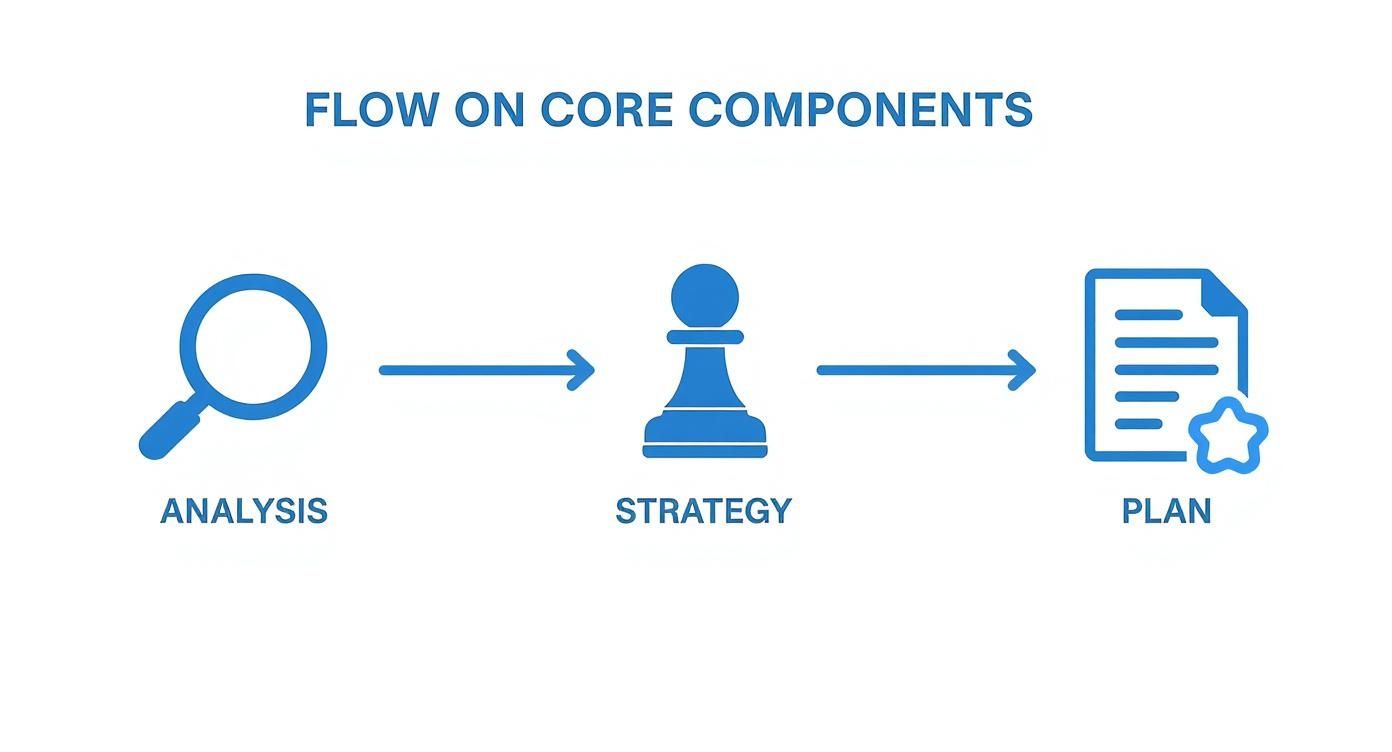
This visual illustrates that a strong BCP is built on a foundation of thorough analysis. That analysis informs the strategies you develop and ultimately document.
Your first move is to assemble a dedicated team. This cannot be a solo mission assigned to the IT department. A robust BCP team needs representation from every critical part of the business—including operations, finance, HR, and communications—to ensure all perspectives are considered.
This cross-functional group will lead the entire process, from the initial analysis to the final documentation, ensuring every part of the business has a voice.
With your team in place, it is time to tackle the foundational steps: the Business Impact Analysis (BIA) and Risk Assessment. This is where your team identifies your most critical processes and the specific threats they face.
For instance, a logistics company might identify its dispatch system as a mission-critical function. A major snowstorm would be a high-probability risk. The BIA would then calculate the financial impact if that system went down for an hour, a day, or an entire week.
Now, you address the "what if" scenarios. Using the insights from your BIA and risk assessment, you can begin building practical strategies to maintain operations. Your strategies should address different kinds of disruptions.
The best business continuity plans are built on clear, simple instructions. When a crisis hits, no one has time to decode a complex manual. They need actionable checklists and direct communication channels to perform their jobs with confidence.
Finally, document everything in a clear, accessible format. A great plan is more than just a list of procedures; it is a practical resource kit for when things go wrong.
Your documented plan should include:
Making this document easily accessible is non-negotiable. Store digital copies in multiple secure, cloud-based locations, and provide key team members with physical copies. After all, a plan you cannot access is a useless plan.
Documenting your business continuity plan is a significant accomplishment, but it is not the final step. A plan that gathers dust on a shelf is worse than having no plan at all—it creates a dangerous false sense of security. For your BCP to be effective when you need it, it must be a living document that evolves with your business. This makes regular testing and maintenance absolutely essential.
Think of it like a fire drill. You would not just write down the evacuation route and consider the job done. You would practise it to identify and resolve any issues before a real fire. The same logic applies here. Consistent testing transforms your BCP from a theoretical document into a practical, battle-tested tool your team can execute with confidence.
The good news is you do not have to simulate a full-blown catastrophe every time you test the plan. There are several ways to evaluate your BCP, each serving a different purpose.
A plan is only as strong as its weakest link. Regular testing is how you find and fix those links before a real crisis does it for you, ensuring your team is prepared, not just informed.
The goal of every test is to identify gaps, refine procedures, and build muscle memory. After each exercise, your team should review what went well and what did not, and immediately update the BCP with those lessons. This is how your plan becomes a dynamic tool for managing risk, not just a static document.
Unfortunately, this is where many businesses fall short. A striking example comes from a survey of SMEs in Dominica and the British Virgin Islands. While about 70% of businesses claimed to have continuity plans, a mere 15% were formally documented, revealing a significant gap in practical readiness. You can discover more insights on this resilience gap. This proves that simply "having a plan" is not enough; it must be formalized, tested, and actively maintained.

A robust business continuity plan is only as strong as the technology it relies on. For many businesses, the technical burden of building and maintaining this foundation is immense. This is where partnering with a managed IT services provider (MSP) becomes invaluable.
An MSP acts as your strategic technology partner, aligning your tech capabilities directly with your continuity goals. They provide the enterprise-grade expertise needed to implement and manage the critical systems that will keep your business running when—not if—a disruption occurs.
An expert IT partner reinforces your BCP by taking ownership of essential technological safeguards.
Partnering with an MSP transforms your BCP from a theoretical document into a technologically-backed, actionable strategy. It gives you the confidence that when a disruption occurs, your systems are prepared to respond immediately.
To fully appreciate their value, it helps to understand the full scope of what an MSP can offer. Exploring the primary benefits of managed IT services shows how their proactive support strengthens not just crisis readiness, but also your daily operations.
To further fortify your plan, tools like an ISMS Copilot can help manage information security—a key pillar of any solid continuity plan.
Even with a clear strategy, questions often arise when it is time to put a business continuity plan into action. Here are straightforward answers to the most common queries from Canadian business leaders.
The timeline for creating a business continuity plan depends on your company's size and complexity. A small business might develop a solid, basic plan in a few weeks. A medium-sized organization with multiple departments and more intricate operations could take two to four months to build a more detailed version.
The key is to start small and build upon it. Aim for progress, not perfection. A simple, tested plan that is functional is far more valuable than a complex one that remains unfinished.
The single most common mistake is creating a plan, filing it away, and never revisiting it. A BCP is not a "set it and forget it" document.
Without regular testing and reviews, your plan quickly becomes outdated and useless. It creates a false sense of security that can be more dangerous than having no plan at all.
An untested plan is just a collection of assumptions. A tested one is a reliable tool you can count on when things go wrong.
As a rule of thumb, you should conduct some form of test at least once a year. However, many businesses find that a more frequent schedule keeps everyone sharp and prepared.
Absolutely. While business continuity planning often brings to mind major events like fires or floods, its principles are designed for any operational disruption. A well-designed plan includes protocols for knowledge transfer and succession planning. These become critical when a key team member leaves unexpectedly, ensuring your business remains stable and productive.
A resilient business continuity plan is built on a solid technological foundation. CloudOrbis Inc. provides the expert managed IT services, data backup, and disaster recovery solutions that Canadian businesses need to turn their BCP from a document into a dependable reality. Protect your operations and secure your future by visiting us at https://cloudorbis.com.
December 15, 2025
Managed IT Services for Alberta Private Career CollegesDiscover managed IT services for Alberta private career colleges. Boost security, compliance, and student success with a dedicated IT partnership.
Read Full Post
December 15, 2025
Small business it support edmonton: A Guide for Local Business LeadersDiscover small business it support edmonton options with clear pricing, expert guidance, and efficient IT solutions for growth.
Read Full Post
December 14, 2025
Small business it support edmonton: A Guide for Local Business LeadersDiscover small business it support edmonton options with clear pricing, expert guidance, and efficient IT solutions for growth.
Read Full Post
