

December 15, 2025
Managed IT Services for Alberta Private Career CollegesDiscover managed IT services for Alberta private career colleges. Boost security, compliance, and student success with a dedicated IT partnership.
Read Full Post%20(1).webp)
Usman Malik
Chief Executive Officer
November 22, 2025
Think of a small business managed service provider (MSP) as your organization's dedicated, on-demand IT department. For a predictable monthly fee, they take the reins of your technology, proactively managing everything from your servers to your employee laptops. The goal? To stop tech problems before they start, freeing you up to focus on what you do best: growing your business.

Alt text: Two professionals working at a desk while a business leader relaxes in a chair near a presentation board, illustrating the peace of mind an MSP provides.
Imagine you are planning a cross-country road trip. You could just get in the car and hope for the best, only scrambling to find a mechanic when you break down on the side of a remote highway. That is a reactive, stressful, and almost certainly expensive way to travel.
Alternatively, you could take your car to a trusted mechanic before the trip. They would perform regular maintenance, check the engine, and replace worn-out parts. This proactive approach all but guarantees a smooth, predictable journey.
That is the core difference between the old "break-fix" IT model and partnering with a modern MSP. Instead of calling for help only when a server crashes, an MSP is always working behind the scenes. They are constantly monitoring, patching, and optimizing to keep your entire technology ecosystem humming along perfectly.
The traditional break-fix model has a fundamental flaw: the IT company only gets paid when your technology fails. Their profit is directly tied to your problems and downtime. It creates a conflict of interest.
An MSP completely flips that script. With a flat-rate monthly fee, their success and profitability depend on keeping your systems stable and secure. Fewer support tickets and emergencies for you mean a healthier bottom line for them. This creates a powerful alignment of interests.
Suddenly, they are not just a vendor you call to put out fires. They become a true strategic partner, invested in making sure your technology actively supports your long-term business goals.
An MSP’s value isn't just in solving today's IT tickets, but in building a technology foundation that prevents tomorrow's emergencies. It is an investment in stability, security, and uninterrupted growth.
As technology gets more complex and cyber threats become more sophisticated, the shift toward MSPs is accelerating. For most medium-sized organizations, building an in-house IT team with the same depth of expertise in cybersecurity, cloud, and network management just is not financially viable.
It is no surprise that a recent study found almost 90% of small and medium businesses either already use an MSP or are seriously considering it. This is not just a trend; it is a strategic response to the realities of the modern business world.
Let's quickly compare the two approaches.
For many businesses, the choice becomes clear when you lay it all out. The MSP model provides a level of expertise and operational maturity that is difficult to replicate internally without a massive budget.
Ultimately, choosing an MSP allows you to offload the technical burden and gain a partner whose success is tied directly to yours.
Partnering with a small business managed service provider lets you:

Alt text: A business growth roadmap showing how MSP services like customer support, security, and planning lead to innovation and success.
Partnering with a managed service provider is about much more than just fixing tech problems as they arise. It is an investment in the very engines that drive your company’s growth. These core services are not designed to just maintain your technology; they are built to turn it into a genuine competitive advantage that boosts efficiency, security, and scalability.
Each service works in tandem with the others to build a resilient foundation for your business. This lets you step away from fighting daily operational fires and focus on big-picture goals. When you understand what these essential services deliver, you can see how they directly translate into tangible business outcomes.
Imagine your top salesperson is minutes away from closing a major deal, but their laptop suddenly freezes. In a traditional IT setup, they might wait hours for a fix, losing critical momentum and maybe even the client. A proactive 24/7 helpdesk completely changes that scenario.
This service is your team’s direct line to expert help, day or night. But it is not just about reacting to problems; it is about preventing them in the first place. Through continuous monitoring and automated maintenance, common issues like software updates and performance tweaks are handled behind the scenes. Your technology just works when you need it most.
This constant watchfulness minimizes downtime, one of the biggest hidden costs any business faces. The result? A more productive, less frustrated team that can count on their tools. This reliability is a cornerstone of the many benefits of managed IT services that smart businesses are embracing.
In our connected world, a single security breach can be devastating. It can lead to massive financial loss, damage to your reputation, and serious legal challenges. A top-tier managed service provider acts as your dedicated security guardian, deploying a multi-layered defence to shield your company from ever-evolving cyber threats.
This goes way beyond basic antivirus software. We are talking about a comprehensive security suite:
Think of it as having your own 24/7 security operations centre (SOC) watching over your digital assets. This proactive approach ensures your data, and your customers' trust, stay protected.
A strong cybersecurity posture is no longer a luxury; it is a fundamental requirement for doing business. An MSP makes enterprise-grade security accessible and manageable for medium-sized organizations.
The cloud offers incredible agility and room to grow, but managing it well requires specialized skills. Whether you are moving to the cloud for the first time or trying to get more out of your current setup, an MSP provides the strategic guidance to make sure you get a real return on your investment. They handle everything from planning a seamless migration to managing your cloud infrastructure for peak performance and cost-efficiency.
A good MSP partner also helps you implement effective IT asset management (ITAM) strategies, covering the entire lifecycle of your hardware and software. This strategic oversight ensures your cloud environment is not just working—it is actively aligned with your goals for growth and innovation.
What would happen if a fire, flood, or ransomware attack wiped out all your company’s data? For many businesses, it would be game over. A solid backup and disaster recovery (BDR) plan is your company’s ultimate insurance policy, ensuring you can get back up and running quickly after the unexpected happens.
An MSP sets up automated, regular backups of your critical data to secure, off-site locations. More importantly, they create and test a clear disaster recovery plan. This means that if a crisis hits, you have a proven, step-by-step process to get your systems back online with minimal disruption and data loss.
Most medium-sized businesses need high-level IT strategy, but they cannot afford the salary of a full-time Chief Information Officer. This is where a virtual CIO (vCIO) service is a game-changer. Your vCIO is a senior technology strategist who works with your leadership team to make sure your IT roadmap perfectly aligns with your business goals.
Your vCIO helps you:
This executive-level guidance makes sure your technology decisions are strategic, not just reactive. It gives you a clear path for using IT to fuel sustainable, long-term growth.
Figuring out the cost of a small business managed service provider can feel murky, but it does not have to be. Most providers build their fees around a few common models, all designed to give you predictable costs and clear value. The real key is to stop thinking of it as a cost and start seeing it as an investment.
The goal is to look past the monthly invoice and understand how a strategic IT partnership generates a return. This happens by heading off expensive problems you are likely not budgeting for right now—like crippling downtime and costly security breaches.
While every MSP has its own approach, their pricing usually fits into a few main categories. Knowing the difference helps you pick a plan that makes sense for how your business operates.
For context, managed IT services typically run between $150 to $250 per user per month in Canada. The final price depends on the complexity of your needs, especially around security and compliance.
The real value of an MSP is not just in the tech support they deliver, but in the disasters they help you avoid. Your true ROI becomes crystal clear when you start adding up the hidden costs of managing your IT alone.
Consider this: what does just one hour of downtime really cost you? For a company with 20 employees who average $35 per hour in wages and overhead, a single hour of lost productivity costs $700 in payroll alone. That does not even touch on lost sales or angry customers. A security breach? That can be even more devastating, with recovery costs easily climbing into the tens of thousands.
An MSP partnership transforms IT from an unpredictable expense into a strategic investment. By preventing costly downtime and security incidents, the service often pays for itself through risk mitigation and improved operational efficiency.
When you bring a proactive MSP on board, you are not just buying IT support; you are investing in your ability to stay in business. Here are the key areas where you will see a tangible return:
When you look at the complete picture, the value is undeniable. A good small business managed service provider does not just manage your technology—they protect your bottom line.

Alt text: Business professionals discuss a cybersecurity compliance checklist, with a shield and lock icon representing MSP protection.
If your business operates in a regulated industry, you know that compliance is not just a friendly suggestion. It is a non-negotiable part of doing business, and the consequences for getting it wrong can be severe. Trying to untangle complex frameworks like Canada's PIPEDA, SOC 2, or HIPAA can feel like a full-time job in itself.
This is where a small business managed service provider becomes a critical partner. They step in to act as your guide and technical enforcer for these intricate rules, translating broad legal jargon into specific, actionable IT policies and controls. With this kind of proactive support, you can build a technology environment that not only keeps you running but actively shields you from costly penalties.
Most compliance standards do not just talk about privacy in the abstract; they demand specific technical safeguards to protect sensitive data. A great MSP takes on the responsibility of putting these controls in place and managing them across your entire IT infrastructure.
Here is what that often looks like in practice:
By managing these technical details, your MSP helps you demonstrate due diligence and prove you are taking data protection seriously. This technical foundation is key to building trust with clients and maintaining a solid reputation. It also ties into broader strategies like proper IT asset management best practices, ensuring every piece of tech is tracked and secured.
A skilled MSP does more than manage technology; they help you manage risk. They transform abstract compliance rules into a tangible security framework that protects your business and your customers.
Compliance is not a "set it and forget it" task. It is a moving target. Regulations evolve, new cyber threats emerge daily, and your own business changes over time. A proactive MSP performs regular risk assessments to find and fix vulnerabilities before they can be exploited.
These assessments are a top-to-bottom review of your entire IT environment. The MSP scans for unpatched software, weak security policies, and misconfigured systems. Afterward, they provide a straightforward report that details the risks they found and lays out a prioritized plan to fix them, keeping you one step ahead of compliance headaches.
Take a healthcare clinic, for example. It might partner with an MSP to ensure its handling of electronic health records (EHR) is fully compliant with PIPEDA. The MSP would implement secure network configurations, manage encrypted backups, and perform regular audits to confirm that all patient data practices meet strict privacy standards. This kind of continuous oversight is vital for any organization handling sensitive information. To see how these principles could apply to your business, explore our expert compliance solutions.
Picking a managed service provider is not like buying office supplies; you are choosing a partner to handle the technological backbone of your business. Get it right, and you will see a real boost in efficiency and security. Get it wrong, and you could face costly downtime, frustrating glitches, and even security breaches.
This checklist is designed to help you cut through the sales pitches and see what a potential provider is really made of. You need to be confident in their technical capabilities, their processes, and even their company culture. Asking the right questions is the only way to know if they are truly equipped to help you grow or just selling a cookie-cutter service.
First things first: qualifications matter. You need assurance that their team has the certified skills to manage your specific technology and that they genuinely understand the world you operate in.
A great starting point is to ask about their team's certifications. Are they up-to-date with major players like Microsoft or Cisco? This shows they are serious about staying current. Just as important, though, is their direct experience with businesses like yours. An MSP that has worked with other companies in your industry already knows your typical workflows, the software you rely on, and your compliance challenges.
That kind of specialized experience is a massive advantage. The IT needs of a law firm are completely different from a manufacturing plant's. Partnering with a provider who has a proven track record in your field means they will not be learning the ropes on your dime.
The discovery process is a two-way street. The way a potential MSP answers your questions says a lot about their maturity, transparency, and whether they are proactive or reactive. Come prepared with a list of questions that go beyond just the price tag.
Here are a few essential questions to get you started:
The quality of their answers is a direct reflection of the quality of their service. Vague, hand-wavy responses are a major red flag—it often means they do not have solid processes in place.
An MSP’s best sales pitch is the success of their current clients. Do not hesitate to ask for case studies or, even better, references from businesses that are a similar size and in the same industry as you. Speaking directly with a current client gives you the unvarnished truth about what it is like to work with them.
When you talk to a reference, get into the day-to-day details. Ask about their communication, response times, and whether the MSP offers any real strategic advice. This is your chance to see if the reality matches the sales pitch.
As you evaluate providers, look for third-party validation, too. Industry lists often rank top MSPs based on growth and client satisfaction. For instance, being named to the prestigious MSP 501 list shows a provider has proven its ability to deliver results through innovation and recurring revenue. Curious about the broader picture? Our guide on choosing an IT outsourcing company can give you more valuable context.
To keep your evaluation organized, a simple scorecard can make all the difference. It helps you compare providers side-by-side on the criteria that matter most to your business.
Using a tool like this helps you move beyond a gut feeling and make a data-driven decision, ensuring you pick a partner that truly aligns with your long-term goals.
Choosing the right IT partner is one of the most important decisions you will make for your company's technology. Checklists and scorecards are a great start, but what really makes a provider stand out is a genuine commitment to your success—backed by an operational model built for the unique needs of Canadian businesses.
This is where CloudOrbis comes in. We are not just another vendor; we are a dedicated partner in your growth.
We understand. The thought of switching IT providers can feel overwhelming. That is why we have spent years refining our transparent, proven 10-step client engagement process. It is our detailed roadmap designed to ensure a smooth transition with as little disruption to your day-to-day operations as possible.
We start with a discovery call and a deep technical assessment, then move into strategic planning and execution. Every step is crystal clear. We do not just show up and take over; we integrate with your team, provide training, and offer ongoing optimization to make sure you see value right away and for the long haul. Our methodical approach takes all the guesswork out of the equation.
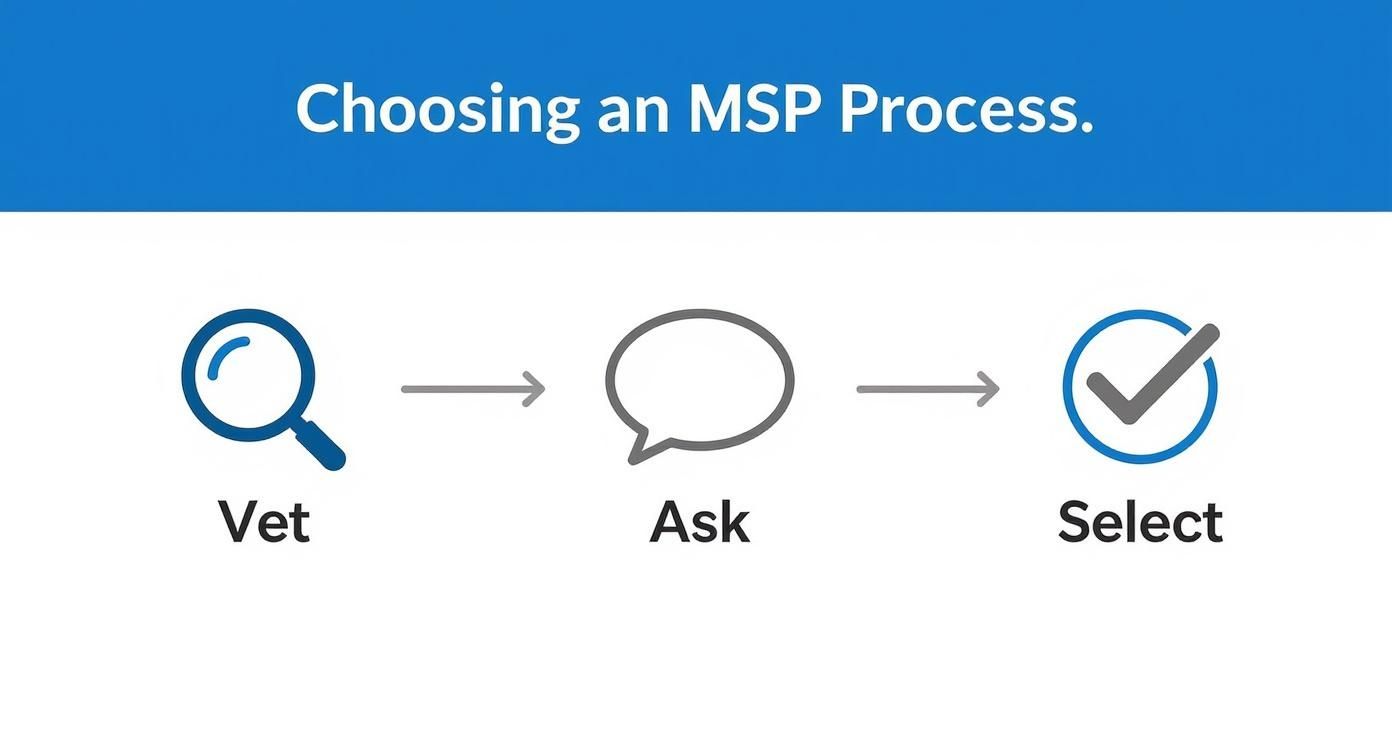
Alt text: A graphic showing a three-step process for choosing an MSP: vet credentials, ask questions, and select the right partner.
This process mirrors the principles we live by: thorough vetting, asking the right questions, and making a strategic selection.
Complexity is the enemy of productivity. Our unique ‘One-Click IT’ philosophy is our direct answer to the complicated, frustrating support systems that plague so many businesses. We give your team simple, immediate access to our helpdesk, empowering them to get the help they need without getting lost in complex ticketing portals.
This straightforward approach delivers:
This commitment turns your IT from a potential headache into a genuine asset.
At CloudOrbis, we believe world-class IT support should be invisible when things are working and instantly accessible when they are not. Our focus is on making your technology powerful, reliable, and remarkably simple to use.
Finally, we do not offer generic, one-size-fits-all solutions. Our foundation is built on a simple yet powerful promise: 100% of our support team is based in Canada. This is not just a point of pride; it is a strategic advantage for you. It means your sensitive data stays within Canadian borders, fully compliant with national data residency and privacy laws.
As a Canadian company, we have firsthand experience with the challenges and opportunities facing businesses in healthcare, manufacturing, and logistics right here at home. We understand the regulatory environment and competitive pressures unique to our market. This focus allows us to provide more than just technical support; we deliver strategic guidance relevant to your goals.
We are here to build a resilient, future-ready technology foundation that scales with your ambition. We are not just a service provider; we are your strategic IT partner, invested in your Canadian success story.
Stepping into a partnership with a managed service provider is a big decision, and it is natural to have questions. To help you feel more confident and informed, we have put together straightforward answers to the things business leaders ask us most often.
This is perhaps the most common myth we hear. The truth is, small and medium-sized businesses often have the most to gain from an MSP partnership. Without the budget for a full-time, in-house IT department, smaller organizations are frequently the most exposed to crippling downtime and cyber threats.
An MSP levels the playing field. It gives you access to enterprise-grade security, tools, and expertise for a predictable monthly fee. It is not about your company's size; it is about understanding that stable, secure technology is the bedrock of growth.
The fundamental difference comes down to their business models and incentives. A break-fix company makes money from your problems—they only get paid when something goes down, which creates a reactive, "firefighting" relationship. Their success is literally tied to your technology failing.
A managed service provider, on the other hand, works on a proactive, flat-fee model. Their profitability depends on keeping your systems running smoothly to prevent support tickets in the first place. This simple shift aligns their interests directly with yours, building a true partnership focused on stopping issues before they ever happen.
A modern MSP places security at the very centre of everything they do. This goes far beyond just installing antivirus software. A truly comprehensive security strategy involves multiple, overlapping layers of protection designed to keep attackers out.
A proactive MSP does not just wait for threats to appear; they actively hunt for vulnerabilities and work to harden your defences. Their job is to make your business an unattractive and difficult target for cybercriminals.
This typically includes a suite of services:
The onboarding timeline can vary depending on the complexity of your current IT setup, but any reputable provider will have a structured, transparent plan. Generally, the process takes a few weeks and is carefully designed to cause minimal disruption to your daily operations.
It usually kicks off with a deep-dive assessment of your existing systems. From there, the MSP deploys monitoring tools, hardens your security, and gets your team acquainted with the new processes. A clear communication plan is key, ensuring you know exactly what is happening at every stage for a seamless, stress-free transition.
Ready to see how a strategic IT partnership can drive your business forward? CloudOrbis Inc. offers a proven, proactive approach to managed IT, tailored for the unique needs of Canadian businesses.
December 15, 2025
Managed IT Services for Alberta Private Career CollegesDiscover managed IT services for Alberta private career colleges. Boost security, compliance, and student success with a dedicated IT partnership.
Read Full Post
December 15, 2025
Small business it support edmonton: A Guide for Local Business LeadersDiscover small business it support edmonton options with clear pricing, expert guidance, and efficient IT solutions for growth.
Read Full Post
December 14, 2025
Small business it support edmonton: A Guide for Local Business LeadersDiscover small business it support edmonton options with clear pricing, expert guidance, and efficient IT solutions for growth.
Read Full Post
