

December 15, 2025
Managed IT Services for Alberta Private Career CollegesDiscover managed IT services for Alberta private career colleges. Boost security, compliance, and student success with a dedicated IT partnership.
Read Full Post%20(1).webp)
Usman Malik
Chief Executive Officer
November 21, 2025

For many Canadian small business owners, IT feels like a constant game of whack-a-mole. A server goes down, a laptop gives up the ghost—you call a technician, get hit with a surprise bill, and cross your fingers it doesn’t happen again. That reactive approach is what we call the 'break-fix' model. It's expensive, disruptive, and a challenging way to run a business.
This is where managed services flips the entire script.
Instead of waiting for something to break, a Managed Services Provider (MSP) works around the clock to prevent problems from happening. It’s a complete shift from reactive firefighting to proactive fire prevention.
Think of your business's technology like the power grid for your home. You don't worry about how the electricity is generated or maintained; you just expect the lights to turn on when you flip the switch. An MSP aims to make your IT just as reliable. They are the expert engineers working behind the scenes, ensuring you have a steady, uninterrupted flow of power so you can focus on what you do best.
The problem with the old break-fix model is the built-in conflict of interest. The technician only gets paid when your systems fail. An MSP, on the other hand, operates on a completely different principle. Their success is directly tied to your stability.
Their goal is to keep your systems running so smoothly that you rarely need to call them. Fewer problems for you means a more efficient operation for them. This alignment turns your IT from a chaotic source of unexpected bills into a predictable, strategic asset that fuels your growth.
A partnership with an MSP fundamentally changes how you manage technology:
By moving away from a reactive model, managed services liberate your team from extinguishing daily IT fires. This freedom allows you to dedicate your time and resources to serving customers, innovating products, and growing your business with confidence.
Ultimately, adopting managed services for small business means you are no longer just buying IT support; you are investing in operational stability, better security, and a clear technology roadmap for the future. For a deeper dive, you can explore our detailed explanation of what managed IT services cover. It is the kind of proactive foundation every business needs to thrive.
So, what are you actually paying for when you partner with a managed services provider (MSP)? It is more than just having an IT person on speed dial. A true MSP partnership gives your small business a complete technology backbone—a suite of essential services that keep you secure, efficient, and ready for growth.
Think of it less like a single product and more like an interconnected system. Each service builds on the others, creating layers of support that turn an abstract IT agreement into tangible, real-world value. Let's break down the pillars that most great MSPs build their service on.
One of the first things you will notice is having a dedicated team ready to help. When a printer suddenly won't connect, a critical application crashes before a deadline, or an employee gets locked out of a file, work grinds to a halt. A managed IT helpdesk support team is your single point of contact for getting those problems solved, fast.
Instead of paying a hefty call-out fee for a technician to show up hours later, your team gets immediate access to experts who already know your systems inside and out. It is all about minimizing disruption so your people can stay focused on their actual jobs. And because tech problems don't keep business hours, any worthwhile MSP offers support around the clock.
Key Takeaway: A 24/7 helpdesk isn’t just about fixing things that break. It’s about giving your team the confidence that expert help is always a quick call or message away, keeping productivity high and frustration low.
The real game-changer here is the shift from putting out fires to preventing them in the first place.
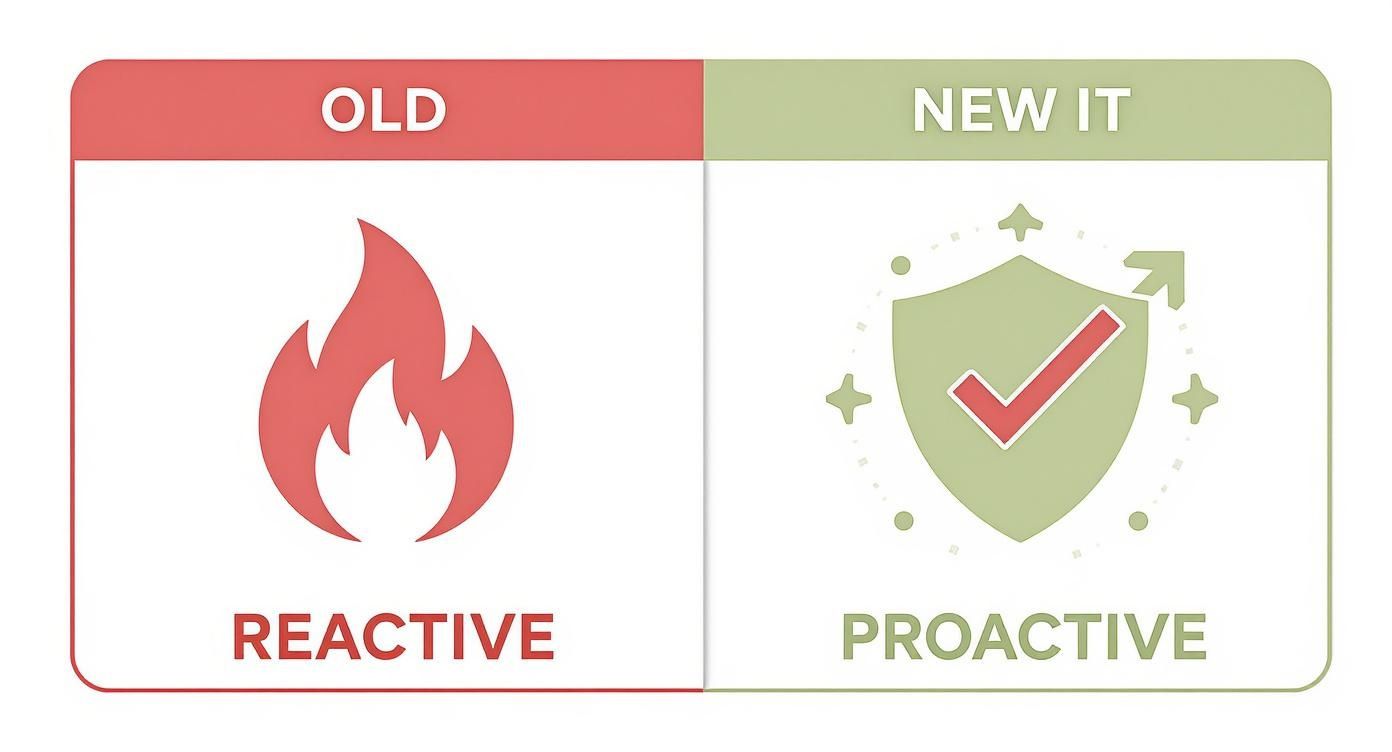
This simple visual nails the difference. The old "break-fix" model was all about reacting to disasters. Managed services are designed to stop those disasters from ever happening.
For any Canadian small business, a single security breach can be devastating. Your MSP acts as your security guardian, building a robust, multi-layered defence to protect everything from sensitive client data to your financial records.
This goes way beyond just installing antivirus software and calling it a day. A proper cybersecurity strategy includes:
A crucial part of this defence involves implementing proven strategies to prevent Man-in-the-Middle (MITM) attacks to ensure communications and data transfers remain private.
Nearly every modern business relies on the cloud for everything from email to file sharing. An MSP helps manage your cloud environments—like Microsoft 365 or Google Workspace—to make sure they are secure, cost-effective, and set up properly for how your team works. They handle the nitty-gritty of cloud migrations and ongoing optimization so you don't have to.
But perhaps the most strategic piece of the puzzle is the Virtual Chief Information Officer (vCIO). This service gives you C-suite technology expertise without the six-figure salary of a full-time executive. Your vCIO gets to know your business goals and builds a technology roadmap to help you get there, advising on budgets, planning for growth, and ensuring you invest in tech that delivers a return.
Ask yourself this: what would happen if a fire, flood, or ransomware attack wiped out all your business data tomorrow? For many, the answer is "we'd be out of business." An MSP implements a solid backup and disaster recovery (BDR) plan to ensure that never happens.
This isn't just about copying files to an external hard drive. It involves automatically backing up all your critical data to a secure, off-site location and, just as importantly, having a tested plan to get your operations back up and running quickly. It is the ultimate peace of mind, knowing your company's most valuable asset—its data—is protected no matter what.
This need for comprehensive protection is fueling massive growth in the industry. The managed services market in the U.S. is projected to hit $69.55 billion by 2025 and could soar to $116.25 billion by 2030, a clear sign that businesses recognize these services are no longer a luxury, but a necessity.
All the technical specifications and service lists are great, but let's get down to what really matters: what does this all mean for your bottom line? Partnering with a Managed Services Provider (MSP) is an investment. Like any smart investment, it needs to deliver a clear, substantial return.
This is where the true power of managed services for small business really shines. It is about shifting IT from being just another expense to becoming a powerful engine for business growth.
The first and most obvious win is ditching unpredictable IT spending. Forget about bracing for a massive, out-of-the-blue bill every time a server gives up the ghost. Instead, you operate on a predictable, flat monthly fee. This simple change turns chaotic, reactive expenses into a stable, manageable operational cost, making your budgeting far simpler and more accurate.

Every minute your systems are offline, your business is actively losing money. Sales grind to a halt, client files are locked away, and your team is stuck, unable to do their jobs. The whole point of proactive IT management is to stop these costly interruptions before they start.
Let's put some real numbers to it.
Imagine a small firm with 15 people, where the average employee brings in about $100 per hour in revenue. If a critical system outage takes your entire team offline for just one hour, that is an immediate $1,500 in lost revenue right there. But the damage doesn't stop. You also have to factor in the hidden costs:
Suddenly, that "one hour" of downtime has a multi-thousand-dollar price tag. An MSP’s primary job is to slash the frequency of these events through constant monitoring and preventative maintenance, directly protecting your revenue. This proactive approach is one of the biggest benefits of managed IT services.
Beyond just preventing disasters, a good MSP actively boosts your team’s productivity. When systems run smoothly and efficiently, your staff can focus on their jobs instead of wrestling with technology. Think faster response times, optimized software, and a reliable network—it all adds up to less time wasted and more work getting done every day.
This shift from reactive fixes to proactive optimization doesn't just save you money on repairs. It actively boosts your revenue-generating capacity by keeping your team productive and focused on what matters most.
This forward-thinking approach is critical for growth. Many Canadian businesses rely on financing to invest in technologies that drive efficiency. You can find more data on how small businesses are investing in technology to learn more about small business trends for 2025.
Finally, let’s talk about the dollars and cents of hiring an in-house IT team versus partnering with an MSP. A full-time IT specialist in Canada requires a competitive salary, benefits, vacation pay, and continuous training just to keep up. For most small and medium-sized businesses, that is a huge, often prohibitive, expense.
With an MSP, you get access to an entire team of certified experts—helpdesk technicians, cybersecurity specialists, cloud engineers, and strategic vCIOs—for what is often less than the cost of a single full-time hire. This shared expertise model gives you enterprise-level knowledge without the enterprise-level price tag. The ROI is simply impossible to match with a small internal team.
If you operate in a regulated industry in Canada, you know that compliance isn’t just a good idea—it is the law. For small businesses without a dedicated compliance officer, navigating the tangled web of data security and privacy rules can be a massive headache. This is where a sharp MSP stops being just a tech provider and becomes your compliance partner.
Handling sensitive information, whether it is patient records, financial data, or confidential project files, requires a careful, documented approach. Dropping the ball on regulations like the federal Personal Information Protection and Electronic Documents Act (PIPEDA) or Ontario's PHIPA can lead to crippling fines, a damaged reputation, and a complete loss of client trust. An MSP is built to help carry that weight.

Compliance is never a one-size-fits-all game. The rules governing a healthcare clinic look nothing like the ones for a construction firm. A specialized MSP understands this and puts the right security controls in place for how your business actually works.
Here are a few real-world examples:
Getting compliant is not a one-time project; it is a constant process. A good MSP bakes compliance right into your day-to-day operations, turning it from a source of stress into something you can manage.
A true expert MSP knows how to translate confusing regulatory language into concrete technical actions. They put the necessary security measures in place, maintain the audit trails you need, run regular risk assessments, and make sure data residency rules are followed. It is all about giving you peace of mind.
This systematic approach is what genuinely shields your business. Instead of reacting to an audit request or a potential breach, you are already operating from a solid foundation of compliance. To see what this looks like in practice, you can learn more about our specific compliance solutions and strategies.
Ultimately, bringing an MSP on board for compliance is about managing risk. You are using their expertise to shield your business from expensive fines and legal headaches, freeing you up to focus on your clients with the confidence that their data—and yours—is safe.
One of the first questions any business owner asks is simple: "How much will this cost?" When you start looking into managed services, understanding the different ways providers price their offerings is crucial. It is not just about the monthly bill; it is about finding a model that gives you predictable costs and real value for your money.
Most Managed Services Providers (MSPs) in Canada stick to a few common pricing structures. Each one is built with a different kind of business in mind. Getting to know them will help you pick a partner whose pricing makes sense for how your company operates.
This is probably the most popular and straightforward approach. With per-user pricing, you pay a flat monthly fee for each employee using your IT services. It's predictable, simple, and incredibly easy to scale up or down.
The beauty of this model is its simplicity. It doesn't matter if an employee uses a desktop, a laptop, and a company smartphone—they are still counted as a single user. This makes it perfect for businesses where people need to work across multiple devices, like consulting firms or sales teams who are constantly switching between the office and the road.
Just like it sounds, the per-device model charges a flat fee for every piece of hardware being managed. This includes every desktop, laptop, server, printer, and even network switch.
This method gives you very granular control over your IT spending and is a great fit for businesses that have a stable, predictable number of devices. For instance, a 50-person manufacturing company with 25 shop-floor workstations and 10 office computers would find this model easy to calculate and track.
This model provides absolute clarity on what is being covered. If a device is on the list, it is managed. If not, it is not. This can be beneficial for businesses that need to track IT assets and costs with precision.
The tiered model bundles services into packages, often with names like Bronze, Silver, and Gold. Each tier comes with a different level of service, so you can pick the one that matches your needs and budget. A basic tier might cover monitoring and helpdesk support, while a premium one could add advanced cybersecurity and vCIO services.
An a la carte model takes this a step further, letting you pick and choose individual services. This is useful for businesses that already have an in-house IT person but just need a hand with specific things, like cybersecurity monitoring or data backup. If you're curious about the numbers, exploring various pricing structures in the market can give you a better feel for the financial commitment.
To help you compare these options at a glance, here is a quick breakdown:
Ultimately, the best managed services for small business don't just sell you a service; they provide a solution. A transparent provider will take the time to walk you through these options, helping you select the model that delivers the most value. This ensures you only pay for what you truly need to keep your business secure, productive, and growing.
Picking a managed services provider is not like buying a piece of software off the shelf; it is about finding a long-term technology partner. The right choice can be a massive tailwind for your business, while the wrong one can lead to constant frustration and expensive disruptions. This decision means looking past the sales pitch to find a provider that genuinely understands what you are trying to achieve.
Think of it like hiring a key employee. You need to check their technical skills, verify their track record, and most importantly, see if they are a good cultural fit. A great MSP does not just fix things when they break—they invest the time to understand your vision and act as a strategic guide.
Before you even start looking at providers, you need to be crystal clear on what you actually need. Are you after someone to take over everything, from end to end? Or do you just need to back up your current IT person with specialized cybersecurity muscle?
A great way to start is by mapping out your pain points and goals. A simple checklist will do:
Having this clarity helps you focus your search and quickly filter out providers that are not the right match. It also protects you from being sold on fancy services that do not actually add value to your bottom line.
Once you have a shortlist, it is time to dig in. The answers to these questions will tell you a lot about a provider’s skills, their processes, and how much they care about their clients.
A truly transparent MSP will welcome these tough questions. Their willingness to give you straight, detailed answers shows they are confident in their services and ready to build a relationship based on trust.
This evaluation is critical no matter where you are, but especially in large, diverse economies. For example, California’s small business sector is home to 4.2 million businesses, with over 700,000 in professional and technical services alone. With a client base that massive, a thorough vetting process is the only way to find a partner you can count on. You can discover more insights about small business landscapes in recent economic profiles.
Finding the right partner is a critical step. For more guidance, check out our guide on how to evaluate top managed IT service companies to make a confident choice.
Making the move to a managed services provider is a big decision for any business owner. It is normal to have questions about how it all works, what the real value is, and what you should expect. Let's tackle some of the most common questions we hear from business leaders across Canada.
Most business owners worry about a long, disruptive transition, but the process is more streamlined than you might think. We have it down to a science. While every business is different, a typical onboarding unfolds over several weeks, not months, and is designed to cause as little disruption as possible.
It starts with a deep-dive discovery phase where we get to know your current IT setup, warts and all. From there, we map out a strategic plan tailored to your goals. The final step is a carefully managed migration. Our priority is a smooth handover with open communication every step of the way, making sure your team feels supported from day one.
This is a myth we love to bust. Managed services for small business often deliver more value for money than any other IT model. Think about it: you get access to an entire team of certified experts for a predictable monthly cost—often less than what you would pay for a single part-time IT person.
For a small business, the expertise gained in cybersecurity, strategic planning, and 24/7 support is an incredible competitive advantage. It levels the playing field, providing enterprise-grade security and reliability that would otherwise be out of reach.
Great partnerships are built on transparency, and that means being upfront about what is covered in your flat-rate agreement and what is not. We believe in setting clear expectations from the get-go so there are never any surprises.
Typically, these items fall outside your monthly fee and are handled as separate line items:
We always discuss these things with you first. The goal is collaboration and ensuring your invoice is always clear, predictable, and fair.
Ready to transform your IT from a source of stress into a strategic asset? The team at CloudOrbis Inc. is here to provide the proactive support, robust security, and expert guidance your business needs to thrive. Book a consultation with us today to discover how our managed services can help you achieve your goals.
December 15, 2025
Managed IT Services for Alberta Private Career CollegesDiscover managed IT services for Alberta private career colleges. Boost security, compliance, and student success with a dedicated IT partnership.
Read Full Post
December 15, 2025
Small business it support edmonton: A Guide for Local Business LeadersDiscover small business it support edmonton options with clear pricing, expert guidance, and efficient IT solutions for growth.
Read Full Post
December 14, 2025
Small business it support edmonton: A Guide for Local Business LeadersDiscover small business it support edmonton options with clear pricing, expert guidance, and efficient IT solutions for growth.
Read Full Post
