

December 15, 2025
Managed IT Services for Alberta Private Career CollegesDiscover managed IT services for Alberta private career colleges. Boost security, compliance, and student success with a dedicated IT partnership.
Read Full Post%20(1).webp)
Usman Malik
Chief Executive Officer
December 16, 2025
When you run a private career college in Alberta, specialized IT compliance services are not just a nice-to-have—they are a critical part of your operational toolkit. This isn't about standard tech support; it's about having an expert partner who understands the unique legal and regulatory landscape you operate in, especially requirements under the Personal Information Protection Act (PIPA).
These services are built from the ground up to tackle data security, meticulous record-keeping, and audit readiness. The goal? To safeguard sensitive student information and, just as importantly, ensure your college keeps its licence to operate.
For Alberta's Private Career Colleges (PCCs), IT management goes far beyond just keeping the Wi-Fi on and the computers running. It's a foundational piece of your regulatory survival. You're operating under the close watch of the Ministry of Advanced Education while also being bound by the privacy mandates of PIPA.
Think about the sheer volume of personal and confidential student data you handle daily. We're talking enrolment applications, financial aid records, academic transcripts, and personal contact details. It's a treasure trove of sensitive information.
A generic IT provider might be great at fixing a network outage, but they often lack experience with Alberta's specific regulatory environment. And that's where the danger lies. A simple oversight or a misstep in compliance can have severe, long-lasting consequences for your institution.
The risks of getting IT compliance wrong are not just hypothetical lines in a government document. They are very real threats that can impact your college's reputation and its very existence.
Here’s what’s really at stake:
Simply put, for a PCC in Alberta, IT compliance is not an expense—it is an essential investment in business continuity and student trust. Your entire IT strategy must be built on a foundation of regulatory awareness.
This guide is designed to give business and IT leaders a clear, actionable roadmap for achieving and maintaining that compliance. We will break down why specialized IT compliance services for Alberta private career colleges are so vital and provide a practical playbook for protecting student data, keeping operations smooth, and making audits a stress-free process.
We provide specialized IT services for education institutions designed to address these exact challenges.
For an Alberta private career college, IT compliance isn't a vague corporate buzzword—it's a concrete set of rules with very real consequences. Think of your two primary guides on this journey as Alberta's Personal Information Protection Act (PIPA) and the Private Career Colleges Act. The first step toward a resilient compliance strategy is understanding exactly how these frameworks connect to your daily IT operations.
PIPA is all about how you handle the personal information of your students, staff, and even prospective applicants. It’s not just about names and addresses. This law covers everything from financial aid details and academic records to sensitive health information provided for accommodations. Your legal duty is to collect this data responsibly, use it only for its stated purpose, and—most importantly—protect it with "reasonable security arrangements."
This means your IT infrastructure must be built to prevent unauthorized access, whether that’s from an external cyberattack or a simple internal mistake. A common scenario, like a student asking for their file, instantly becomes a PIPA compliance test. You need a secure, documented process to verify their identity and provide the information without accidentally exposing anyone else's data.
While PIPA is laser-focused on data privacy, the Private Career Colleges Act dictates operational integrity, which has massive IT implications. The Act demands meticulous record-keeping for everything from student enrolment contracts to attendance logs and academic progress reports. These are no longer just paper files in a cabinet; they are digital records that must be accurate, secure, and available at a moment's notice.
Imagine a surprise inspection from the Ministry of Advanced Education. An inspector could walk in and ask to see the complete academic and financial records for a specific group of students. Your IT systems have to be able to produce those records promptly and accurately. If your data is a disorganized mess, inaccessible because of a server failure, or corrupted, you are officially non-compliant.
The real takeaway here is that both PIPA and the PCC Act require more than just having IT systems. They demand systems that are secure, reliable, and auditable. Your technology isn't just a tool for education—it's a primary instrument of your regulatory compliance.
Alberta's government has been sharpening its focus on accountability. PCCs are monitored through annual reporting and on-site inspections, and they must maintain minimum graduation and employment rates of 70%. Failing to hit these numbers can lead to compliance orders or even licence suspension, which really drives home how critical accurate data management is. You can learn more about Alberta's rigorous compliance requirements for PCCs directly from the source.
To really get a feel for these obligations, let's walk through a few real-world examples that bring the rules to life:
These scenarios make it clear that compliance is not about having policies gathering dust in a binder. It’s about embedding those rules into your IT infrastructure and daily workflows. Every digital touchpoint, from the first application to the final graduation, has to be viewed through a compliance lens. Our expert team specializes in creating robust IT compliance solutions that tackle these specific regulatory challenges head-on.
A solid compliance strategy doesn’t kick off with buying new software or drafting policies. It starts with a clear-eyed understanding of where your risks truly lie. For an Alberta private career college, that means running a practical IT risk assessment built for your unique environment—a process that cuts through the technical jargon to focus on real-world threats to your student data and daily operations.
This isn’t just a box-ticking exercise for an audit. A thorough risk assessment is your strategic map. It shows you exactly where to invest your time and money for the biggest impact on your security and compliance.
Before you can protect anything, you need to know what you have and why it matters. The first phase is to map out your critical digital assets. This means identifying and categorizing all the information and systems essential to your college's function and regulatory duties.
Think beyond just servers and laptops. Your most valuable assets are the data they hold:
Once identified, you have to classify these assets based on their sensitivity. Student financial records, for instance, are highly sensitive under PIPA, making their protection a top priority. A systematic approach to cybersecurity risk management is the best way to formalize this crucial first step.
The visual below breaks down the key compliance stages—PIPA, the PCC Act, and Audits—that your IT risk assessment must cover.

This flow highlights how understanding your obligations under each framework is fundamental to spotting relevant risks and getting ready for any scrutiny.
With your assets mapped out, the next move is to figure out what could realistically harm them. This means looking at both external threats and internal vulnerabilities. Threats are the "what could happen," while vulnerabilities are the "why it could happen to us."
A common mistake is focusing only on sophisticated hackers. While cyberattacks are a real threat, the risk of an internal mistake—like an employee accidentally emailing a sensitive student list to the wrong recipient—is often just as high, if not higher.
This is especially true as the sector grows. Private career colleges in Alberta have seen student enrolments surge by over 30% in the last five years. This growth is what pushed the government to launch the Private Career College Registry, aiming for more transparency. It came partly because surveys found that up to 40% of students felt misled about costs and job prospects. These figures show just how intense the scrutiny is on PCC operations and why flawless data handling is essential for maintaining trust.
Here are a few common vulnerabilities we see in educational settings:
To bring it all together, a focused risk assessment should scrutinize specific areas of your IT environment. The table below outlines key domains, the kinds of threats they face, and how they tie back to your compliance obligations under PIPA and the Private Career Colleges Act.
This table provides a solid framework for starting your assessment. By methodically working through these areas, you can ensure no stone is left unturned.
You cannot fix everything at once. The final step is to prioritize, and this is where a risk matrix becomes your best friend. A risk matrix helps you score each identified risk based on its likelihood (how probable it is to happen) and its impact (how damaging it would be).
For example, a ransomware attack on your student information system would have a catastrophic impact, even if its likelihood is only moderate. On the other hand, a minor software glitch might be highly likely but have a low impact. By plotting these risks on a matrix, you can visually separate critical issues that need immediate attention from minor problems that can be dealt with later.
This data-driven approach turns your to-do list into a strategic action plan. It guarantees you’re putting your resources where they will make the most difference in securing your college and staying compliant. By systematically assessing your assets, threats, and vulnerabilities, you empower your team to shift from a reactive to a proactive security posture.
Your IT risk assessment has given you the blueprint. Now, it's time to start building. Turning that analysis into real-world protection for your college is not a one-and-done task; it’s a deliberate, multi-layered approach to security. This means putting in place both the technical safeguards that act as your digital locks and the administrative policies that guide your staff and students.
For any private career college in Alberta, these controls are non-negotiable. They are the tangible proof that you’re taking the "reasonable security arrangements" required by PIPA and the Private Career Colleges Act to protect the sensitive student data you handle every day.
The goal here isn't to lock everything down so tight that it disrupts learning. It’s about weaving these protections into the daily fabric of your operations, making good security a seamless part of how everyone works.
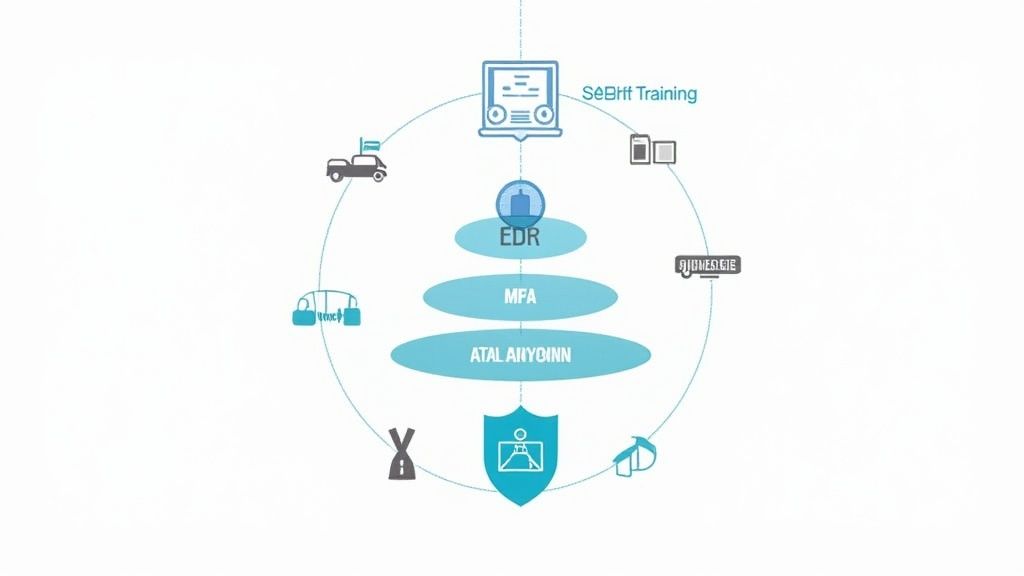
Think of technical controls as your security team working 24/7 to defend your network, devices, and data. They are your first line of defence against both opportunistic hackers and sophisticated threats.
Here are the absolute must-haves for any modern school:
Getting these controls right is paramount. For a deeper dive into protecting educational environments, this guide on comprehensive cybersecurity measures for schools is an excellent resource.
While technology gives you the tools, your administrative policies create the rules of the road. These documents define what’s acceptable, establish clear procedures for everything from new hires to data breaches, and form the backbone of your entire compliance program. Come audit time, they are critical for demonstrating due diligence.
Your policies are not just for the IT department; they're for every single person in your organization. They translate abstract compliance requirements into clear, actionable instructions for your staff and students.
Remember, effective policies are living documents, not just files collecting dust on a server. They need to be communicated clearly, understood by everyone, and reviewed regularly to keep up with new technologies and threats. Our team helps build these out, but if you’re curious about the ongoing management side, you can read our guide on what to expect from managed security services.
Understanding what each control does helps you prioritize your efforts. This table breaks down a few key security measures, their primary function, and why they are so important for staying compliant with PIPA.
By strategically combining these technical and administrative controls, you create a defence-in-depth security posture. This layered approach ensures that even if one control fails, others are there to stop a threat, protecting your college and fulfilling your obligations to your students.
Picking an IT provider is a big deal for any business, but for an Alberta private career college, the stakes are so much higher. Your operating licence and the sensitive data of your students are on the line, which means not all IT support is created equal. The real challenge is looking past a standard Managed Services Provider (MSP) and finding a true compliance partner—someone who lives and breathes the regulatory world you operate in every day.
A generic MSP will keep your network running and your computers patched. Their world revolves around uptime and technical fixes. But when you need IT compliance services for Alberta private career colleges, you need a team that already understands the ins and outs of PIPA and the Private Career Colleges Act before they even walk through your door.
It all comes down to their core mission. An MSP’s job is to manage your technology. A compliance partner’s job is to use technology to protect your college by aligning every system and process with your legal and regulatory obligations.
You’ll see this difference in stark relief the moment an auditor shows up. An MSP might be able to pull server logs if you ask. A compliance partner, on the other hand, will hand you audit-ready reporting that directly answers PIPA’s requirements for safeguarding information. They’re already thinking about what inspectors will ask for and have the documentation prepared.
A true compliance partner doesn’t just fix problems—they prevent them by building a security and compliance framework around your operations. Their success is measured not by tickets closed, but by risks mitigated and audits passed.
The regulatory heat on career colleges isn't going away. Gaps in compliance and enforcement are a known issue across Canada, and Alberta is no exception. One report noted that as of June 2021, only about 30% of PCC campuses were inspected within the target three-year window, and some inspections were even halted. When they did happen, the findings revealed serious problems, from outdated program approvals to difficulties in enforcing penalties. This just highlights the intense scrutiny your college is under. You can read the full findings on PCC regulatory challenges to get a clearer picture.
When you sit down with potential providers, you need to probe deeper than just their technical skills. You’re trying to find out if they’re fluent in Alberta’s regulatory language and have specific, hands-on experience in the education sector.
Here are the critical questions you should be asking:
Their answers will tell you everything you need to know. A generalist will stumble. A specialist will speak confidently about PIPA, share stories from past educational audits, and show you a clear, documented process for responding to incidents. Making the right choice is fundamental, and it helps to understand what a great IT outsourcing company can offer your business in a broader sense.
The best compliance partners often provide services like a virtual Chief Information Security Officer (vCISO). This gives your college access to executive-level security strategy without the six-figure salary of a full-time hire. A vCISO is the person who translates complex compliance rules into a practical, long-term security roadmap, making sure your IT investments are both strategic and completely defensible.
Ultimately, choosing the right partner is about finding an extension of your own team. You're looking for someone who brings that specialized compliance knowledge to the table, freeing you up to focus on what you do best: educating your students.
Here's the thing about IT compliance: it isn't a one-and-done project you can tick off a list. For an Alberta private career college, true compliance is a continuous journey. It's about diligence, adaptation, and weaving security into the very fabric of how your college operates.
This ongoing commitment is what genuinely protects your institution, your students, and your reputation from the threats and regulatory scrutiny that are always evolving. Think of it less like a project and more like an operational rhythm. You regularly review policies, assess new risks as you adopt new tech, and constantly reinforce best practices with your team. This is how you build real, long-term resilience.
The first move is to get a practical, repeatable schedule on the calendar for reviews and assessments. You cannot let your policies and risk assessments become static documents that just gather digital dust.
Your schedule should lock in a few key activities:
Proactive compliance management does more than just tick boxes. It shifts your IT from a defensive cost centre into a strategic asset. It proves to regulators, students, and partners that you are a trustworthy custodian of their sensitive information.
Getting a call from the Ministry of Advanced Education or the Office of the Information and Privacy Commissioner (OIPC) does not have to be a code-red panic. If you've got a proactive compliance program running, an audit is simply a chance to show off your commitment to doing things right. Preparation is everything.
Having your documentation organized and easy to grab is half the battle. When an inspector asks for something, you want to be able to produce the evidence confidently and quickly.
Here’s a quick checklist of what you should have ready to go:
By taking control of your IT compliance, you set your college up for sustained success. CloudOrbis is the expert partner ready to help you build and maintain this resilient framework.
Navigating IT compliance often brings up a lot of questions, especially for administrators and IT leaders at Alberta's private career colleges. Let's tackle some of the most common ones we hear from our partners.
For smaller colleges working with a tight budget, the single most effective first step is a practical IT risk assessment. Honestly, you cannot protect what you do not fully understand.
This process is all about mapping out where your sensitive student and operational data lives and identifying your biggest weak spots. It allows you to strategically focus your limited time and money where it will have the greatest impact.
The cost of IT compliance services for Alberta private career colleges really does vary. It depends on your college's size, how complex your current IT setup is, and what security measures you already have in place.
A smaller institution might just need a foundational package to get started—think risk assessments and policy development. A larger college, on the other hand, might require ongoing vCISO services and advanced security monitoring to stay on top of things.
The best way to look at it is as an investment, not just another expense. The cost of building a proactive compliance program is always, without fail, less than the financial and reputational fallout from a data breach or a licensing issue.
While Alberta’s Personal Information Protection Act (PIPA) is the big one for data privacy, it’s definitely not the only rulebook in play.
The Private Career Colleges Act carries its own significant IT implications. It has specific requirements for record-keeping, ensuring data is available for audits, and maintaining operational integrity. A solid compliance strategy has to tick the boxes for both frameworks to make sure you're truly covered.
Ready to build a resilient, audit-ready IT compliance framework for your college? CloudOrbis provides expert guidance and managed services to help you navigate Alberta's regulatory landscape with confidence. Let's talk about your compliance needs.
December 15, 2025
Managed IT Services for Alberta Private Career CollegesDiscover managed IT services for Alberta private career colleges. Boost security, compliance, and student success with a dedicated IT partnership.
Read Full Post
December 15, 2025
Small business it support edmonton: A Guide for Local Business LeadersDiscover small business it support edmonton options with clear pricing, expert guidance, and efficient IT solutions for growth.
Read Full Post
December 14, 2025
Small business it support edmonton: A Guide for Local Business LeadersDiscover small business it support edmonton options with clear pricing, expert guidance, and efficient IT solutions for growth.
Read Full Post
